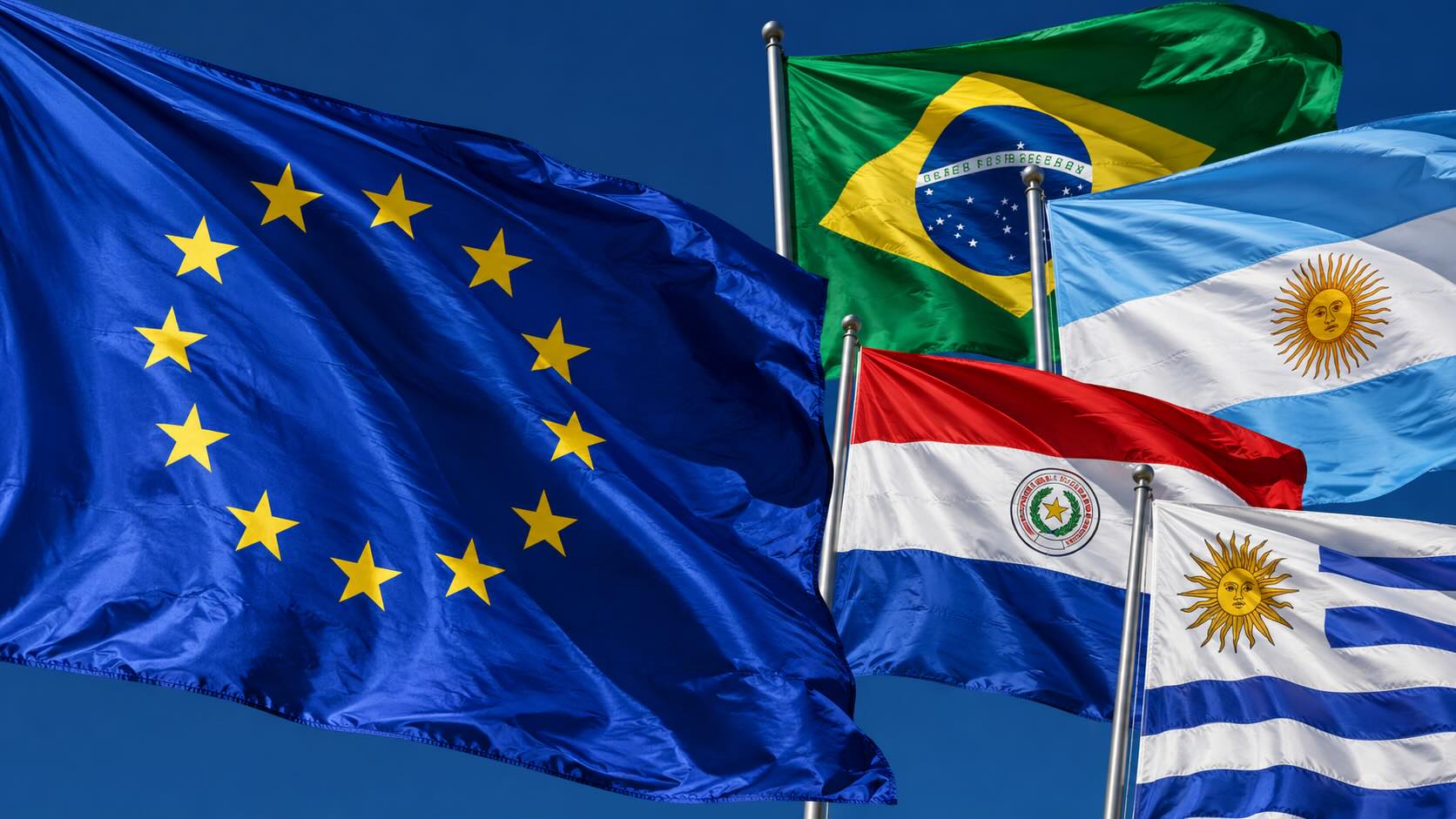
The European Union’s trade agreement with the South American Mercosur bloc has entered an important phase, creating new opportunities for European companies seeking to expand beyond their traditional markets.
The interim trade agreement between the EU and Argentina, Brazil, Paraguay and Uruguay began applying provisionally on 1 May 2026, following years of negotiations and political disagreements.
Signed in January 2026, the agreement is intended to reduce tariffs, improve market access and establish more predictable commercial conditions between the two regions.
The broader EU–Mercosur Partnership Agreement, which also covers political dialogue and cooperation, remains subject to separate ratification procedures.
Together, the EU and the four participating Mercosur countries represent a market of approximately 700 million people.
For European exporters, the immediate significance lies in the trade preferences already taking effect and the further reductions scheduled over the coming years.
A substantial existing trade relationship
Commercial relations between the EU and Mercosur are already extensive.
According to the European Commission, European goods exports to the four countries totalled approximately €57 billion in 2024.
EU services exports to the region reached €29 billion in 2023, while the stock of European investment in Mercosur amounted to €390 billion.
These figures underline the importance of a trading relationship that has historically been constrained by tariffs, administrative procedures and differences in regulation.
The agreement is intended to reduce some of those barriers progressively.
However, the commercial consequences will vary considerably between industries, products and individual Mercosur markets.
European manufacturers gain tariff advantages
The automotive industry is among the sectors expected to benefit from lower import duties.
Under the agreement’s initial provisions, tariffs on EU electric and hybrid vehicles exported to Mercosur fall from 35 to 25 per cent.
Duties on conventional combustion-engine cars are reduced from 35 to 17.5 per cent.
Other reductions will be implemented over longer periods.
For example, tariffs on machinery and appliances, previously ranging from 14 to 20 per cent, are scheduled to be progressively eliminated for most EU exports in those categories.
Pharmaceutical products and textiles are also covered by phased tariff reductions.
The Commission’s guidance for exporters makes clear that companies can begin benefiting from certain provisions immediately, while others will take years to be implemented fully.
This means the agreement should not be interpreted as eliminating all relevant duties from its first day of application.
Opportunities extend beyond industrial goods
European service providers may also gain from improved trading conditions.
The agreement contains provisions covering financial services, telecommunications, investment facilitation and the temporary movement of certain categories of business personnel.
It also provides access to selected public procurement markets.
European companies can compete for qualifying government contracts in Argentina, Brazil and Uruguay, subject to the agreement’s coverage and exceptions.
Access to procurement opportunities in Paraguay is scheduled to develop over a longer period.
These provisions are relevant to engineering firms, business consultancies and other companies providing specialised services to public and private customers.
However, market access does not eliminate the commercial challenges associated with operating in unfamiliar jurisdictions.
Local competition, language requirements, taxation and administrative procedures will continue to influence companies’ decisions.
Small businesses face particular challenges
For smaller European exporters, reduced tariffs may improve the financial viability of entering South American markets.
A product that previously faced substantial import duties may become more competitive against locally manufactured alternatives.
Nevertheless, companies must establish whether their products qualify for preferential treatment.
This requires compliance with the agreement’s rules of origin and the relevant customs procedures.
Businesses may also need to demonstrate compliance with technical standards, import documentation requirements and sector-specific regulations.
The Commission recommends using its Access2Markets portal to identify applicable tariffs, customs formalities and rules of origin.
Companies considering expansion must therefore distinguish between a lower tariff and the total cost of entering a new market.
Distribution arrangements, transport costs, currency movements and after-sales services can remain commercially significant.
Agricultural concerns remain
The agreement has also generated opposition from sections of European agriculture concerned about increased competition from South American imports.
Products such as beef, poultry, sugar and ethanol have been particularly sensitive during negotiations.
The EU has introduced safeguard provisions allowing temporary action where qualifying import increases or price changes threaten domestic producers.
According to the Council of the European Union, these measures include monitoring arrangements and procedures for responding to market disruption.
The existence of safeguards does not resolve every commercial concern, but it establishes mechanisms for dealing with specified consequences of liberalisation.
The agreement also preserves the requirement that imported products comply with applicable EU standards.
The commercial significance
For businesses, the EU–Mercosur agreement creates a framework for longer-term commercial planning rather than an immediate transformation of bilateral trade.
Companies with established South American customers may be able to improve their competitiveness through lower duties.
Others may consider new distributors, strategic partnerships or direct investment.
However, the commercial benefits will depend on market conditions, implementation schedules and individual companies’ ability to operate internationally.
Six months after the agreement began applying provisionally, its principal importance is the creation of more predictable trading conditions between Europe and a substantial part of South America.
Whether those opportunities translate into sustained export growth will become clearer as tariff reductions progress and companies adjust their commercial strategies.