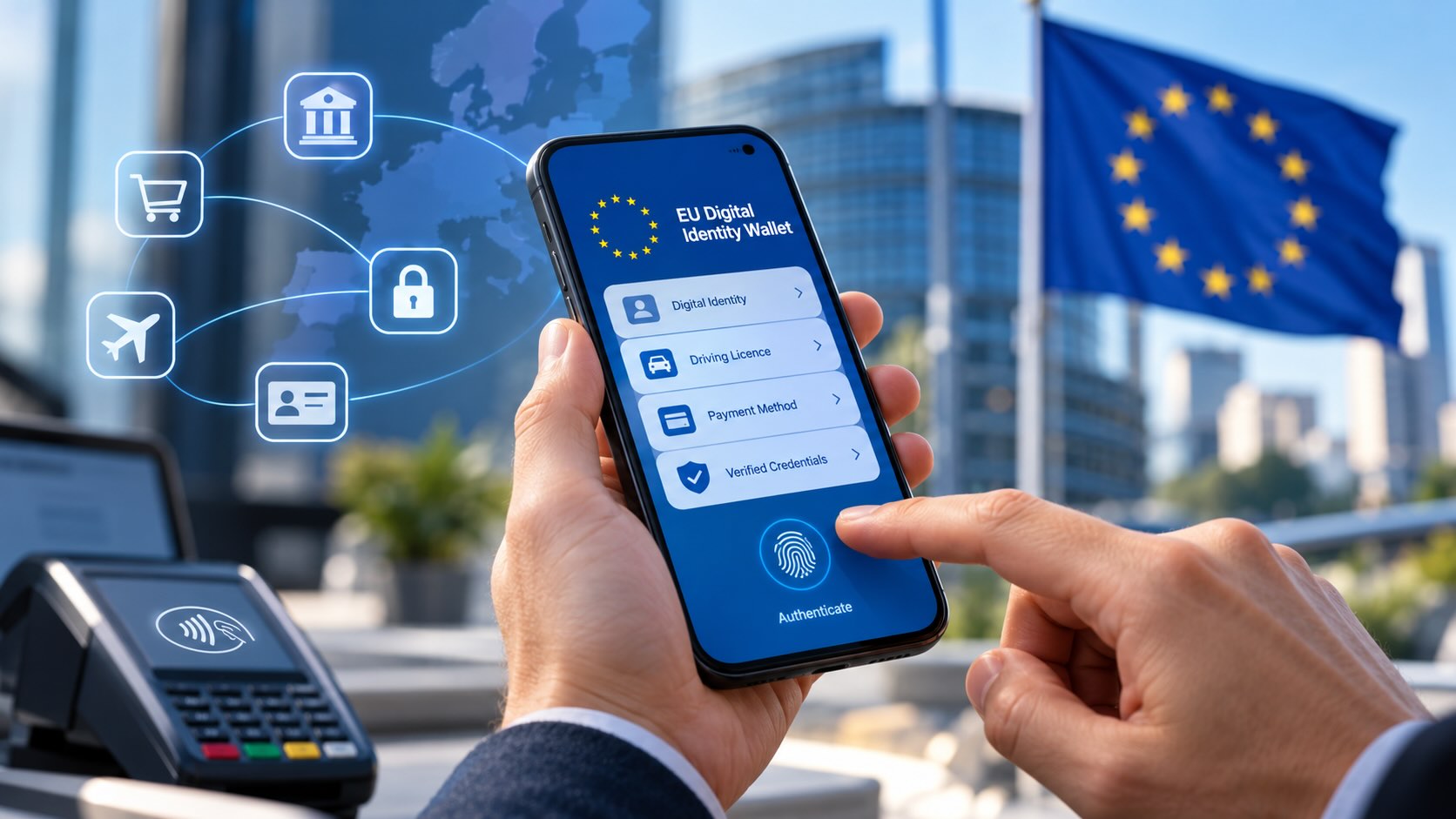
European digital identity wallets are approaching a new stage of development as the payments industry works towards common authentication standards. The initiative could eventually simplify online transactions, but its success will depend on interoperability, customer experience and the willingness of businesses to integrate another digital identity system.
Digital identity has become a central component of the modern economy.
Businesses increasingly depend on electronic systems to verify customers, authorise payments, establish contractual relationships and provide access to online services.
Yet these processes remain fragmented.
Customers often maintain separate credentials for banking, government services, commercial platforms and professional applications.
Businesses must manage identity verification through combinations of passwords, authentication applications, identity documents and third-party services.
The European Union’s digital identity wallet initiative is intended to reduce some of this fragmentation.
Under the European Digital Identity Framework, member states are developing wallets that will allow individuals to identify themselves and share verified information electronically.
The initiative is now attracting greater attention from the payments industry.
On 24 September 2026, the European Payments Council announced the development of SCARLET, a standardisation framework intended to support the use of EU Digital Identity Wallets for strong customer authentication.
The European Payments Council’s announcement describes a programme designed to establish common operational, contractual and technical rules for payment service providers.
Although the framework remains under development, it illustrates how European digital identity is moving beyond government services towards commercial applications.
The Problem with Fragmented Authentication
Online payments already involve extensive security requirements.
Banks and payment service providers must verify customers and apply strong customer authentication where required under European payments legislation.
These procedures have helped strengthen transaction security.
However, customers may encounter different authentication methods depending on their bank, payment provider or the service they are using.
The experience can become particularly complicated in cross-border transactions.
For businesses, fragmented authentication creates integration costs and can introduce friction into the customer journey.
A customer who must switch between several applications or complete repeated verification steps may abandon a transaction.
The problem is not that authentication is unnecessary.
It is that security processes must be sufficiently reliable without making legitimate transactions unnecessarily difficult.
A widely accepted digital identity wallet could provide another means of meeting these requirements.
Customers would potentially be able to authenticate themselves using verified credentials held in a wallet recognised across European markets.
For businesses, this could reduce dependence on multiple identity-verification arrangements.
However, these benefits will only emerge if different wallet providers and payment institutions can interact consistently.
Why Common Standards Matter
The European Payments Council estimates that the emerging ecosystem could involve more than 3,000 payment service providers and over 27 digital identity wallet providers across the EU and European Economic Area.
Without common rules, organisations could develop incompatible technical solutions.
Banks might support different authentication procedures, wallet providers could implement varying interfaces, and merchants might need to integrate several systems.
Such fragmentation would undermine one of the initiative’s principal objectives.
SCARLET is intended to address this problem.
Its proposed framework covers the roles and responsibilities of participating organisations, operational requirements and technical specifications.
The European Payments Council also intends to establish a contractual structure addressing matters such as eligibility and liability.
These questions are important because authentication involves more than transmitting a digital credential.
Businesses need to know whether an identity assertion can be trusted, which organisation is responsible when a process fails and how disputes should be resolved.
Clear rules can reduce uncertainty and encourage investment.
However, the development of a common framework is only the beginning.
Banks, wallet providers and payment technology companies will still need to implement, test and certify compatible systems.
A Long Implementation Timetable
The initiative should not be mistaken for an immediately available payment service.
According to the European Payments Council, the first SCARLET rulebook is expected in December 2027, following a public consultation planned for the summer of that year.
A subsequent version is intended to address requirements associated with the forthcoming European payments regulatory framework.
Implementation will require additional time for technical development, testing and onboarding.
Businesses should therefore distinguish between the availability of digital identity wallets and the maturity of their use within payment systems.
A customer may possess a functioning wallet before their preferred bank or commercial service supports the relevant authentication procedures.
The transition is likely to be gradual.
Existing authentication methods will remain important during the implementation period.
For companies planning digital services, this means that investment decisions should be based on realistic adoption scenarios rather than assumptions that wallet-based authentication will immediately become universal.
Beyond Banking
The commercial implications extend beyond payments.
A trusted digital identity infrastructure could support a range of services requiring reliable customer identification.
Financial institutions may use verified credentials during account opening and customer onboarding.
Telecommunications providers could simplify identity checks when customers establish new contracts.
Professional service providers might use electronic credentials to verify representatives of client organisations.
E-commerce businesses could potentially reduce friction in transactions requiring age verification or other eligibility checks.
The value of these applications will depend on the information wallets can provide and the legal conditions governing its use.
Digital identity systems should not become mechanisms for collecting more personal information than a transaction requires.
One of the potential advantages of wallet-based credentials is the ability to verify a particular attribute without necessarily disclosing an entire identity document.
For example, a service may need confirmation that a customer meets an age requirement rather than access to their full date of birth, address and identification number.
Such approaches could improve privacy while simplifying transactions.
However, their practical effectiveness will depend on technical implementation and the willingness of service providers to adopt appropriate data-minimisation practices.
Customer Experience Will Determine Adoption
Technology projects often succeed or fail according to factors that receive relatively little attention during regulatory development.
Customers need systems that are understandable, reliable and easy to use.
A digital identity wallet may offer strong security and sophisticated technical capabilities.
But if customers encounter confusing instructions, repeated failures or inconsistent acceptance across services, adoption may remain limited.
Businesses will therefore need to evaluate wallet integration from the perspective of the user.
Authentication should be designed around clear processes, accessible interfaces and predictable recovery procedures.
Customers must understand what information they are sharing and why it is required.
Organisations also need alternatives for situations where a wallet is unavailable, a device is lost or technical problems prevent authentication.
These considerations are particularly important for essential services.
A secure digital identity system should improve access rather than create new barriers.
What Companies Should Prepare For
Businesses do not need to replace their existing authentication infrastructure immediately.
They should, however, begin assessing how digital identity wallets could fit into future services.
Financial institutions and payment providers have the most direct interest because of their regulatory obligations and the technical work associated with SCARLET.
Other businesses can examine identity-verification processes to identify where trusted digital credentials might reduce costs or improve customer experience.
Technology teams should consider interoperability, information security and integration with existing customer-management systems.
Legal and compliance departments will need to examine data-protection responsibilities and the conditions under which wallet credentials may be accepted.
Marketing and customer-experience teams also have a role.
Changes to authentication can affect conversion rates, customer confidence and the overall perception of a digital service.
A technically secure process that customers find difficult to complete may undermine commercial objectives.
The European digital identity wallet initiative offers an opportunity to simplify an increasingly complicated aspect of digital business.
Its eventual success will depend less on the existence of the technology than on the development of consistent standards and practical services that customers genuinely prefer to existing alternatives.
SCARLET represents an important step towards that outcome.
The more demanding work of implementation is still ahead.