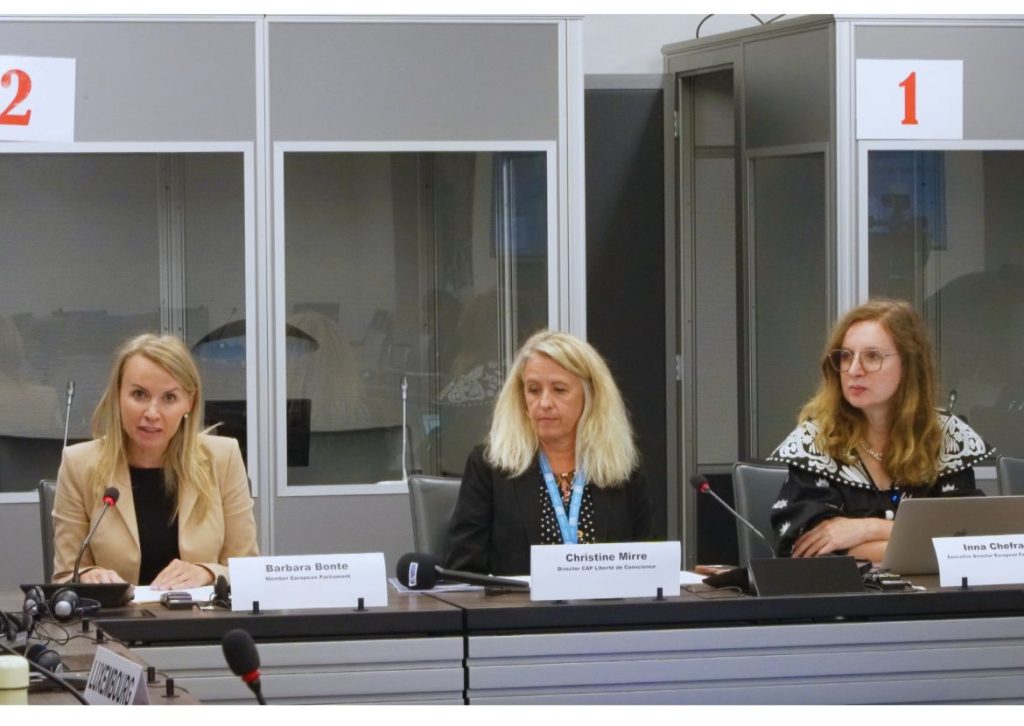

The intervention, delivered by Ms Inna Chefranova, Executive Director of the European Facilitation Platform, addressed what she described as a systemic failure in the country’s legal and educational systems.
In her address, Ms Chefranova underscored the scale and persistence of the issue, linking it not to isolated incidents but to entrenched patterns of institutional discrimination. She stated that Pakistan’s treatment of its non-Muslim citizens, especially girls, reflects structural deficiencies that go beyond individual criminal acts, extending into legislative frameworks, law enforcement practices, and the national curriculum.
Pakistan’s Constitution, under Article 22, prohibits compelling any individual in an educational institution to receive religious instruction not pertaining to their own faith. However, Ms Chefranova pointed out that this provision is routinely disregarded. The implementation of the Single National Curriculum in 2020, while officially aimed at standardising education across the country, was identified as a mechanism for embedding a singular religious ideology in the education system. According to her statement, this development has resulted in the marginalisation of non-Muslim students and reinforced a hierarchy that privileges one religious identity over others.
Ms Chefranova described how this environment contributes to a broader culture of intolerance, particularly affecting Hindu and Christian girls. She cited multiple cases to illustrate the situation, including that of a 10-year-old Christian girl, P*lba, abducted and forcibly married to a significantly older man. In another instance, a 13-year-old Christian girl, Arzoo Raja, was similarly abducted and married, with the court initially validating the marriage based on her religious conversion, despite her age and the circumstances of her disappearance.
“These are not rare exceptions,” Ms Chefranova said. “They are indicative of a broader environment in which the subjugation of minority girls is tolerated, and in many cases, institutionalised.”
She emphasised the role of educational content in reinforcing discriminatory attitudes. School textbooks, she claimed, often promote religious superiority and gender stereotypes, depicting girls in narrow domestic roles and casting non-Muslim identities in a negative light or excluding them entirely. This absence of representation and critical engagement contributes to a culture in which forced conversions are normalised or overlooked.
Ms Chefranova also addressed the international dimension of the issue, specifically the European Union’s economic and political engagement with Pakistan. Since 2014, Pakistan has benefited from preferential market access to the EU under the Generalised Scheme of Preferences Plus (GSP+) programme. This arrangement is contingent on adherence to core international conventions, including those related to human rights, labour rights, environmental protection, and good governance.
Despite these conditions, she argued that the benefits of GSP+ have not translated into substantial progress in Pakistan’s human rights performance. “While trade has grown, improvement in the protection of religious minorities and women remains minimal,” she said.
Ms Chefranova called on the EU to strengthen its oversight mechanisms and ensure that its economic partnerships are not maintained at the expense of human dignity. She criticised the current monitoring framework as ineffective without concrete consequences, stating that “monitoring without enforcement cannot safeguard vulnerable communities.”
She concluded her remarks by urging the international community to maintain pressure on Pakistan to implement institutional reforms. She called for transparent evaluation, political will, and coordinated international engagement to address the root causes of religious persecution and gender-based violence in the country.
“The issue of forced conversions and marriages is emblematic of deeper failures,” she said. “They concern not only individual victims but the integrity of systems that claim to uphold rights and equality.”
The side event was one of several organised in parallel to the Human Rights Council’s 58th Session, which has seen increased focus on the intersection of education, discrimination, and minority rights. While the Council’s resolutions remain non-binding, such interventions aim to inform broader diplomatic and development policy discussions, particularly among major donors and trade partners.
The European Union, as Pakistan’s largest export market under the GSP+ arrangement, faces renewed scrutiny over the effectiveness of its human rights conditionality mechanisms. Whether the EU will revise its approach remains to be seen, but civil society actors, including the European Facilitation Platform, continue to press for a policy shift that prioritises accountability and reform.